Choose liquid detergent if you regularly wash cold or want one product for washing and label-approved stain pretreatment. Consider powder if your washer accepts it, the formula suits your usual temperature, and its cost per correctly dosed load is lower. Neither form wins every load: formulation, dose, and machine compatibility matter more than the package shape.
This is a label- and manufacturer-guidance comparison, not a laboratory ranking of detergent brands. It does not establish which product cleans best in your water or washer.
The useful differences at a glance
| Your priority | Start by considering | What could change the decision |
|---|---|---|
| Mostly cold washes | Liquid | A powder specifically formulated for your temperature may also work; check its directions |
| Direct pretreatment of washable greasy marks | Liquid with pretreatment directions | The garment and product labels must permit the treatment |
| Mud or clay on everyday washable clothing | Powder as a candidate | The actual formula and washing instructions still decide suitability |
| A liquid-only automatic dispenser | Compatible liquid | Powder may require a separate single-load compartment, if the manual allows it |
| Lowest ongoing expense | Whichever has the lower calculated cost per your load | Dose, concentration, local price, and rewashing can reverse the result |
Whirlpool describes liquid as easy to dissolve in cold or warm water, while undissolved powder can leave residue. Its product-help guidance generally favors powder for mud or clay and liquid for oily soils. Those are starting points, not guarantees about every formula. Whirlpool detergent comparison; Whirlpool product help.
Check the machine before buying a large package
Find two separate answers in the washer manual: Does it require HE detergent? Where does this detergent format go? A front-loading door does not tell you everything about the dispenser, and a top-loading washer can also be high-efficiency.
HE is a formulation requirement, not a synonym for liquid. Whirlpool explains that HE detergent is designed to produce fewer suds in low-water washing; regular detergent should not replace it in an HE machine. Look for the HE marking on the detergent, then follow your model’s loading directions. Do not mix powder and liquid together in the same dispenser. Whirlpool’s HE guide.
If you use automatic dosing, note its exact permitted detergent type and concentration setting. A bottle that works in a single-load compartment is not automatically suitable for a bulk reservoir. Treat that question as a compatibility check before comparing cleaning claims.
Match the product to what you actually wash
Think about the last three loads, not a hypothetical worst stain. Were they lightly worn shirts, muddy sports clothing, or items with cooking-oil spots? That identifies whether pretreatment convenience or routine washing is your bigger problem.
Tide describes its liquids as useful for direct pretreatment and greasy marks, and also describes powder products that work in cold washes. That is why “powder never works in cold water” is too broad. Check the specific package rather than buying on the strength of a format-wide rule. Tide’s detergent guide.
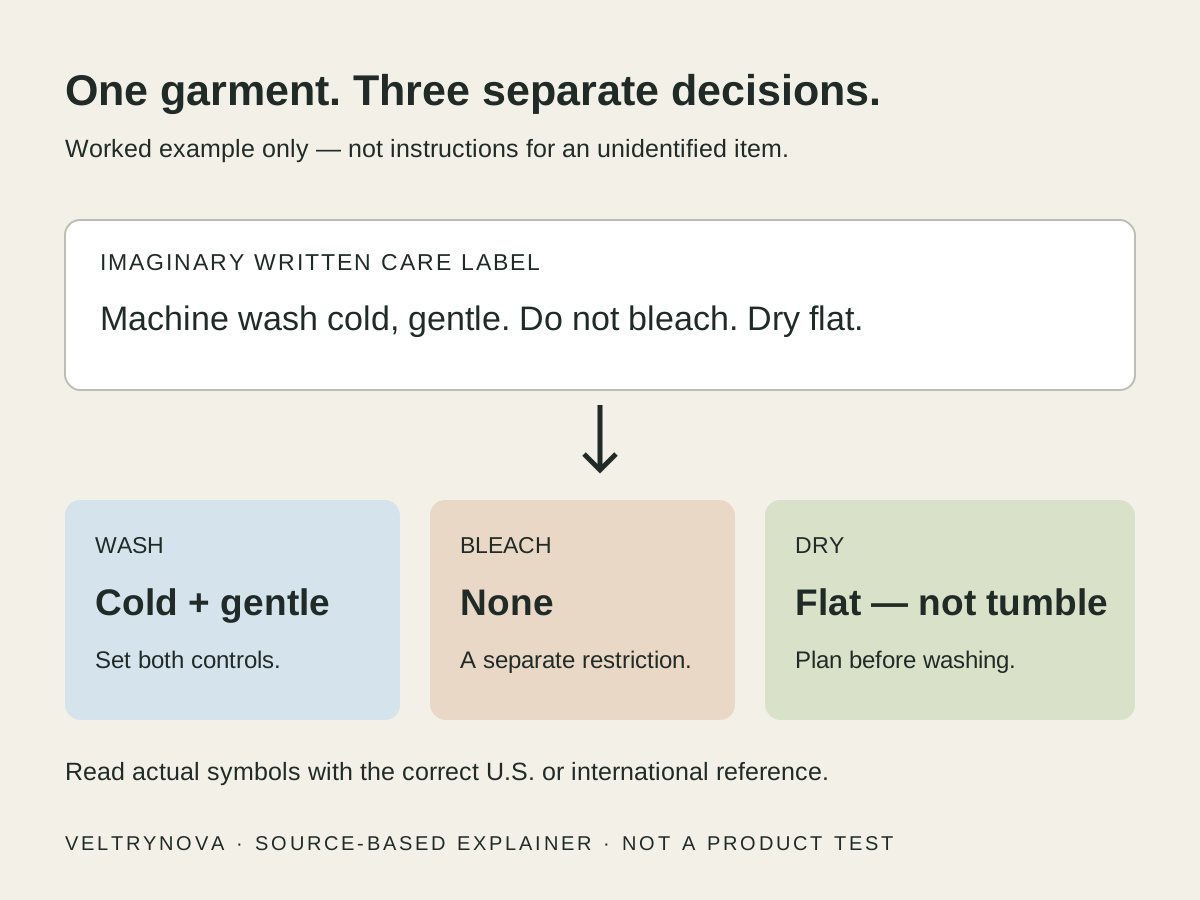
For pretreatment, use a product with directions for that use; follow its contact time and garment restrictions. Do not improvise a strong paste or leave concentrated detergent on a delicate fabric just because a different product permits it. The detergent choice must fit the garment’s care instructions, which our laundry-label guide helps decode.
Compare cost per load, not cost per bottle
A large bottle and a smaller box cannot be compared by container size. Use this worksheet with the packages in front of you:
| Write down | Liquid candidate | Powder candidate |
|---|---|---|
| Price you will actually pay | ___ | ___ |
| Amount in the package | ___ fl oz or mL | ___ oz by weight or g |
| Label dose for your load and soil level | ___ in matching units | ___ in matching units |
| Package amount ÷ that dose | ___ loads | ___ loads |
| Price ÷ calculated loads | ___ per load | ___ per load |
Keep weight and liquid volume separate. If a label only provides scoop lines and a stated load count, use that count only when its stated dosing conditions match your laundry; otherwise mark the comparison uncertain rather than inventing a conversion.
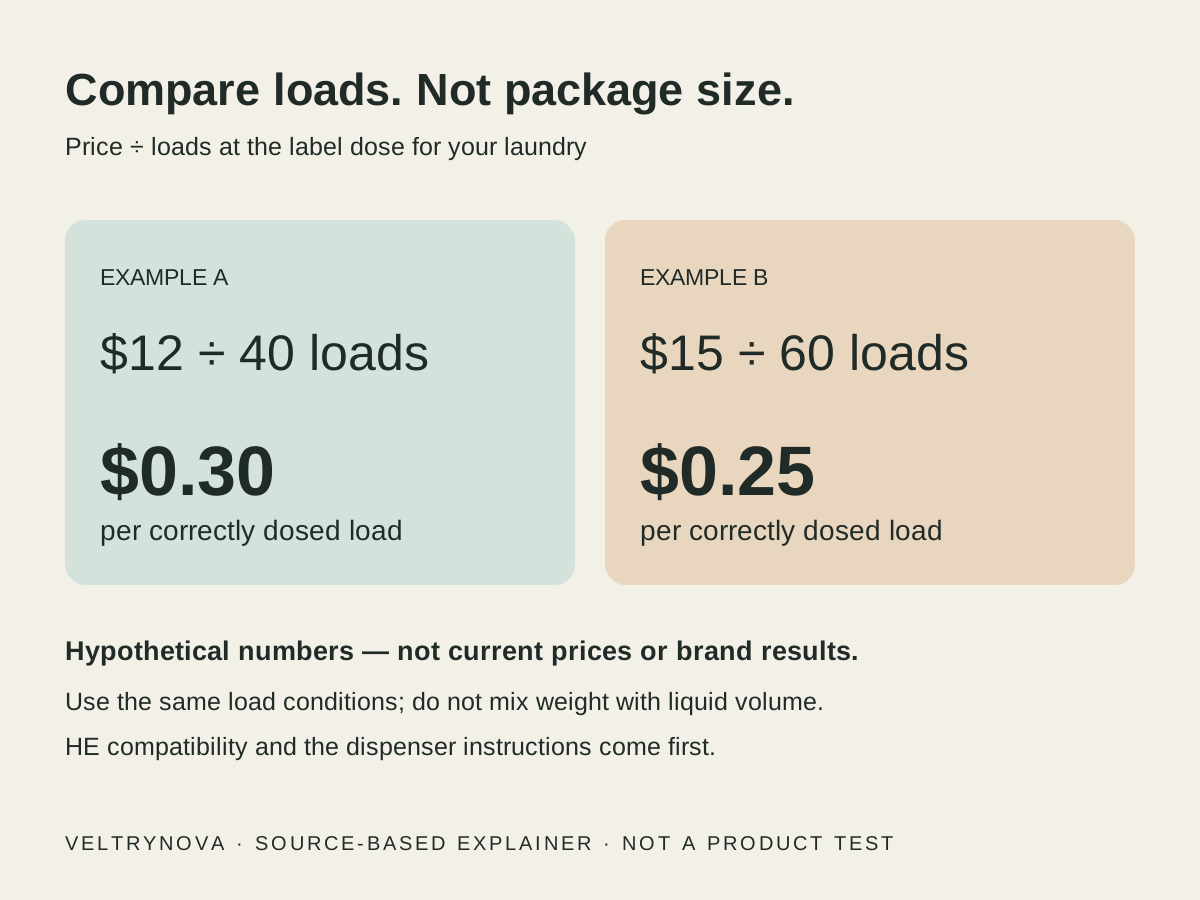
The calculation is an editorial budgeting method, not measured price data. For illustration only, a $12 package providing 40 of your correctly dosed loads costs $0.30 per load. A $15 package providing 60 costs $0.25. Those numbers are hypothetical, not current store offers.
Whirlpool’s dosing guidance identifies load size, soil level, concentration, and water hardness as relevant variables. Use the product’s measuring cap or scoop and directions instead of a universal spoonful recommendation. Whirlpool dosing guide.
If residue appears, troubleshoot before buying another detergent
Write down the formula, measured dose, cycle, and load size. Then check whether you used the permitted compartment and whether the load was packed too tightly. Whirlpool identifies excess detergent, incomplete dissolution, and overloading as possible contributors to poor results. Its advice to change temperature must still fit the garment’s care label. Whirlpool troubleshooting guidance.
Change one factor at a time within those instructions. If you change detergent, temperature, dose, and load size together, a cleaner result will not tell you which purchase was necessary.
The practical choice: keep the detergent that is compatible with your machine, performs adequately on your normal loads at its stated dose, and costs less for the work you actually need. If your current product already does that, this comparison is not a reason to replace it.