Read the shape first, then its dots, bars, number, or cross, and finally any written instructions. The washtub concerns washing; the triangle concerns bleach; the square concerns drying; the iron concerns ironing; and the circle concerns professional care. A cold wash does not automatically permit machine drying, and a washable fabric does not automatically permit bleach.
You do not need to memorize a whole symbol chart. You need a short set of instructions for this garment: how to wash it, whether bleach is permitted, and how to dry it. Read ironing and professional-cleaning instructions before using those treatments too.
Start with these five families
| What the mark resembles | What to read from it | What not to infer |
|---|---|---|
| Washtub | Hand or machine washing, temperature, cycle restrictions | The dryer setting |
| Triangle | Whether bleach is allowed, and which kind | That white fabric automatically permits chlorine bleach |
| Square, sometimes containing a circle | Natural drying or tumble-drying instructions | That a drying prohibition bans washing too |
| Iron | Permitted ironing heat and steam restrictions | A setting based only on the fabric name |
| Circle | Professional cleaning instructions | Permission to run the washer’s delicate cycle |
The American Cleaning Institute’s guide groups the symbols by treatment and summarizes two useful patterns: more dots indicate more heat, while more bars indicate gentler treatment. A cross means the pictured treatment is not permitted. Read these as separate instructions, not a score for how “tough” the whole garment is.
Numbers are not always Fahrenheit
When a wash tub contains a number such as 30 or 40 in the ISO system, that number is the maximum temperature in degrees Celsius, not Fahrenheit. The bars beneath the tub limit mechanical treatment: one indicates a milder process and two a very mild process. GINETEX’s washing-symbol explanation.
For orientation, 30°C equals 86°F; 40°C equals 104°F. Those are unit conversions, not an assurance that a washer’s button labeled “Warm” delivers exactly that temperature. Use the machine’s manual to match the label to a supported setting.
Do not apply one internet dot-temperature chart to every label you own. The FTC notes that U.S. ASTM symbols and international ISO symbols are similar but not identical. If an imported item’s symbol seems inconsistent with a chart, use the garment maker’s explanation for that item instead of guessing from the nearest-looking icon. FTC care-label guidance.
Translate the whole label before sorting
Use this small worksheet when a label is unfamiliar. It is an editorial organizing tool, not a replacement care label.
| Decision | Your note |
|---|---|
| Wash method | Machine / hand / do not wash / unresolved |
| Maximum temperature and cycle | ___ |
| Bleach restriction | ___ |
| Drying method and heat | ___ |
| Additional words | Wash separately / reshape / other: ___ |
| Ironing, if needed | ___ |
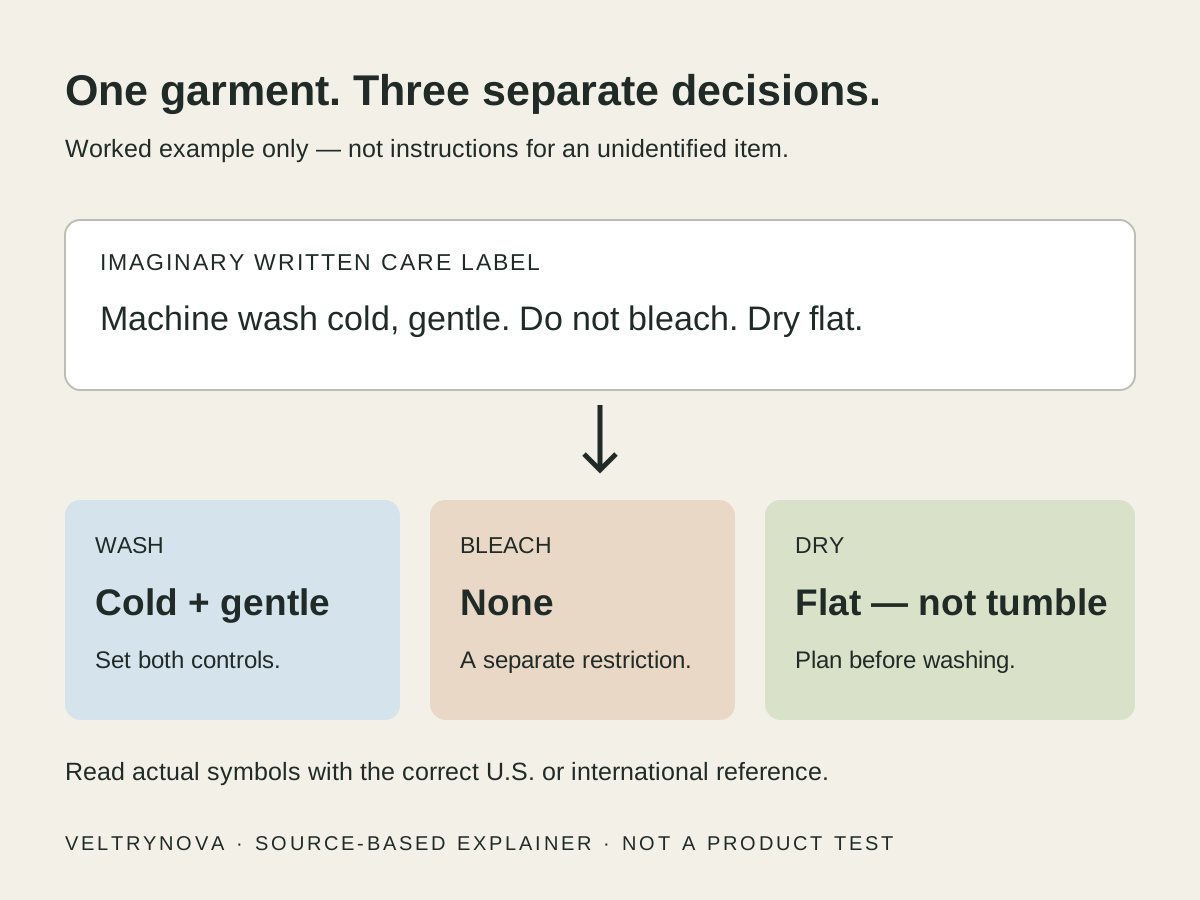
Here is a worked reading example, not a recommendation for an unidentified garment: suppose a label says machine wash cold on gentle, do not bleach, and dry flat. Your note becomes “cold + gentle / no bleach / flat dry.” It does not become “cold wash and low dryer heat.” The drying instruction rules out that substitution.
This also explains why sorting only by color is incomplete. Two dark garments may require different wash methods; two items sharing a wash cycle may need different drying methods. Make the drying separation before a wet load is automatically transferred into the dryer.
Bleach symbols answer a different question from detergent choice
In the ISO chart, an empty triangle permits oxygen or chlorine bleach, a triangle with two diagonal lines permits oxygen bleach but not chlorine bleach, and a crossed triangle prohibits bleach. GINETEX’s bleaching section.
Written U.S. labels may instead say “Only non-chlorine bleach, when needed” or “Do not bleach.” The FTC guidance gives those as distinct restrictions; they are not interchangeable. FTC bleaching instructions.
Read the laundry product’s directions as well. A product’s color, fragrance, or powder/liquid form does not tell you that it fits the garment’s bleaching restriction. Our powder-versus-liquid comparison separates detergent format from machine compatibility and dosing.
Do not turn a drying mark into an ironing instruction
A circle inside a square relates to tumble drying; a standalone iron relates to ironing. Dots need to be read within their own symbol family, not transferred from dryer to iron. The ACI chart separates these heat settings and also shows no-heat tumble drying, no tumble drying, no steam, and no ironing as different instructions. ACI fabric-care guide.
Likewise, a circle with professional-cleaning letters is not a household washing program. GINETEX explains that these letters concern professional cleaning processes; a household washer cannot reproduce the professional process just by selecting a gentle cycle. GINETEX professional-care section.
If the label is missing or unreadable
Do not substitute the fiber-content tag for the care label. Note the brand, style number, lining, trim, and any remaining words, then look for that exact item’s care directions. While checking, keep it out of a load that would commit you to an uncertain treatment. For a valuable or structured garment, ask the maker or a professional cleaner rather than experimenting with a wash-and-dry combination.
Once you have the correct instructions, photograph the label and save it with the item name. The useful outcome is not knowing more symbols: it is having a clear plan before water, bleach, or heat makes the decision irreversible.