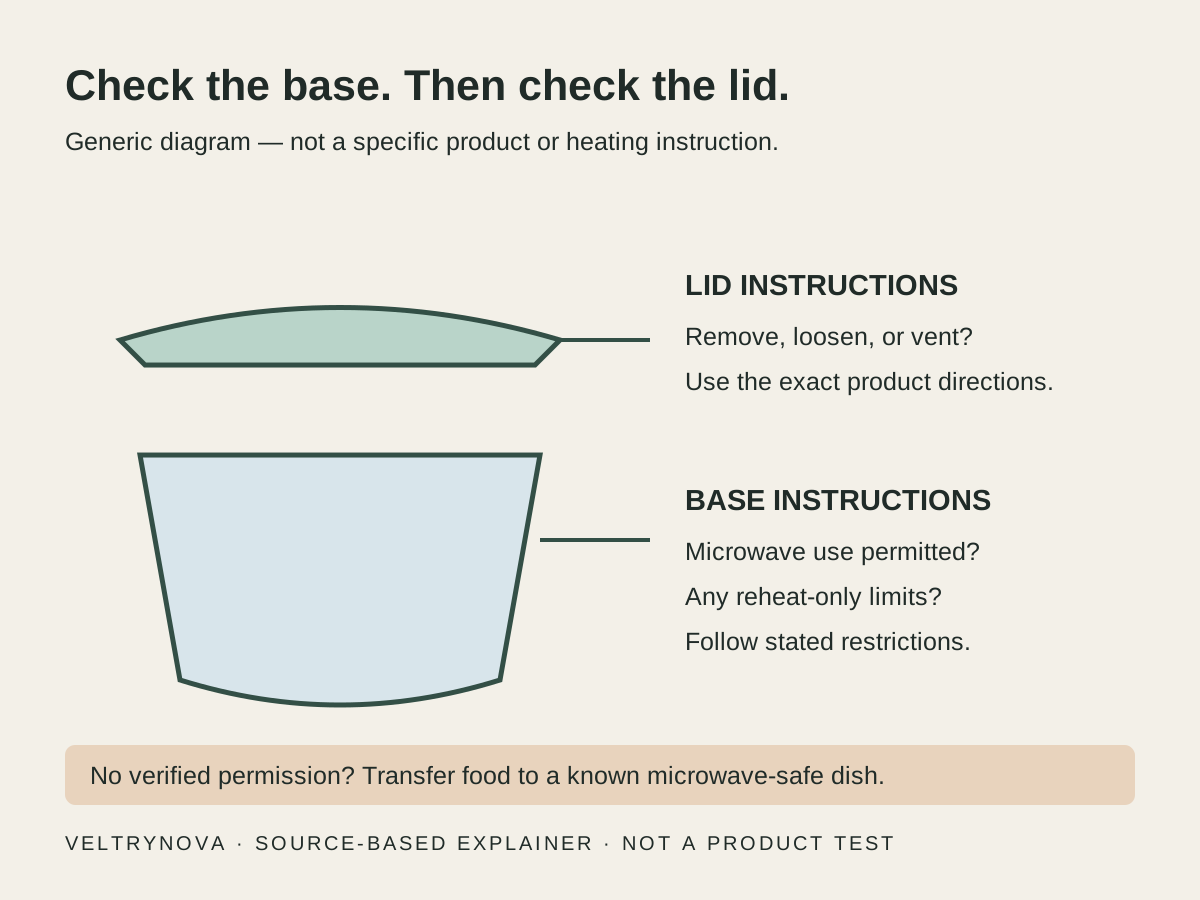
Use a container for microwaving only when its labeling or the exact product’s instructions permit that use. Then check the lid separately: it may need to come off, sit loosely, or have a vent opened. A freezer mark, dishwasher mark, recycling number, or “BPA-free” claim does not by itself give you those heating instructions.
If you cannot establish microwave permission for the container you have, move the food to a known microwave-safe dish. Do not use “it survived last time” as a test of suitability. The FDA recommends cookware specifically made for microwave use.
Read the markings by the job they authorize
Turn over the base, then look at the lid, packaging, and care sheet. Translate each mark into a separate question:
| What you find | What it helps answer | What remains unanswered |
|---|---|---|
| Explicit microwave-use wording and directions | Whether this item is intended for that heating use | Lid position, food restrictions, and other stated limits |
| “Reheat only” | A limited use, not unrestricted cooking | The time, power, and food limitations in that product’s instructions |
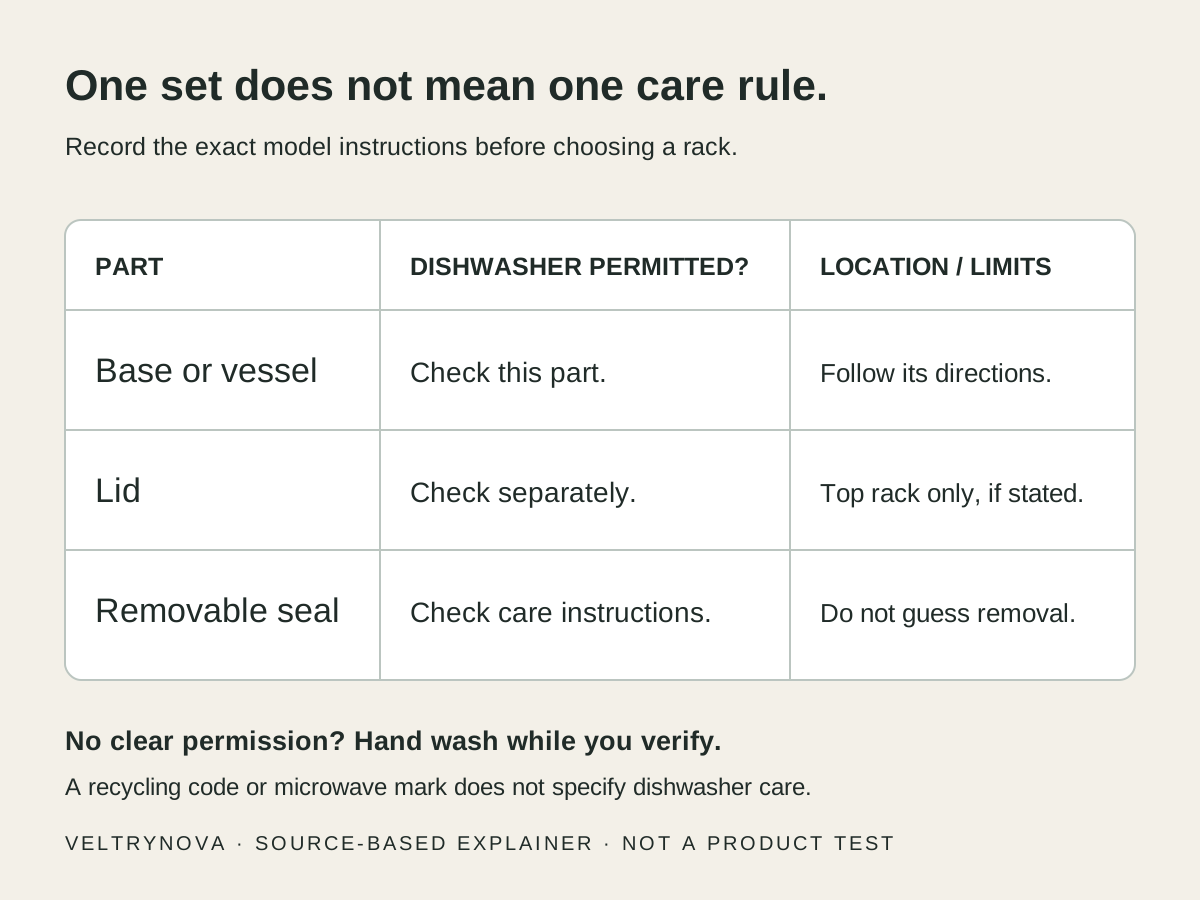
| Dishwasher or top-rack wording | How it can be washed | Whether it can be microwaved |
| Freezer wording | Whether freezer storage is permitted | Whether it can go directly from frozen storage to heating |
| Resin/recycling number | Information about material classification | Microwave use, venting, or heating duration |
| “BPA-free” | A claim about one substance | Whether this particular base and lid are approved for microwave use |
This is a decision table, not a universal icon dictionary. Use a maker’s description when an unfamiliar pictogram is the only information available. The FDA’s BPA explanation discusses resin codes as material information; its separate microwave guidance addresses cookware suitability. They answer different questions.
The lid is not an interchangeable accessory
A lid that snaps onto a dish is not automatically the right lid for heating. Check the product family or model identifier, especially when several similar containers share a cupboard.
For a concrete example, the Pyrex FAQ says its covers must be unsealed and placed off-center when microwaving so steam can escape. The company’s use-and-care page also gives different instructions for plastic lids, wood lids, and various Snapware accessories. Some product sections call for lid removal, while others specify venting or offsetting. Follow the section for your item rather than borrowing directions from another set.
That difference matters when shopping too. “Includes lids” is a storage feature; it does not explain the reheating workflow. Before buying, look for instructions that say what happens to the lid during heating and whether your intended food is within the stated use.
Glass versus plastic is not enough information
Material names are useful, but they are not a complete care label. The FDA explains that containers can become hot from the food inside and that some plastic containers can melt from that heat. It also notes that metal can interfere with heating and potentially damage an oven; use the oven’s own directions for permitted cookware. FDA microwave guidance.
Nor does a rigid, attractive plate necessarily belong in the microwave. The FDA specifically advises against heating food or drinks on melamine-based dinnerware. Microwave-safe cookware can be used to heat the food before serving it on the melamine plate. FDA melamine tableware guidance.
At the other end of the spectrum, do not assume all glass storage vessels are identical. Pyrex’s glassware instructions prohibit use of chipped, cracked, or severely scratched pieces and warn against sudden temperature changes. Those are product-use restrictions, not a claim that every glass container elsewhere is safe under the same conditions. Pyrex glassware instructions.
Make a three-line record for containers you use repeatedly
For each container family, save a photo of the markings and write:
- Base: exact model or product family, microwave permission, any heating restrictions.
- Lid: approved lid, remove/vent/offset instruction, and any separate restrictions.
- Other uses: washing rack, freezer permission, and oven permission, each recorded separately.
For example, Rubbermaid’s Brilliance set identified as model 2108389 lists microwave, freezer, and top-rack dishwasher compatibility. Those are three distinct claims for the listed set, not permission to apply that same care plan to every Rubbermaid product.
The point of the record is to eliminate repeat guesswork, not create another labeling system. Keep the manufacturer’s wording with the product name; do not shorten “reheat only” to “all cooking.”
Four quick decisions before you press Start
| Situation | Next action |
|---|---|
| Base is identified and permitted, but lid directions are unclear | Use the lid only after confirming its own instructions; use a known permitted cover if needed |
| Container has only a material or recycling mark | Transfer food to a known microwave-safe dish unless you can verify the exact model |
| Two similar sets have become mixed | Match parts and product identifiers before treating either as a complete heating system |
| Directions permit reheating but you want prolonged cooking | Use cookware whose instructions cover that cooking task |
This guide checks container selection, not whether a particular meal has reached a safe temperature. Food-heating requirements are a separate question; a microwave-safe bowl does not certify the food inside it. For washing the same container afterward, use our dishwasher-marking guide rather than carrying microwave permission across to another appliance.