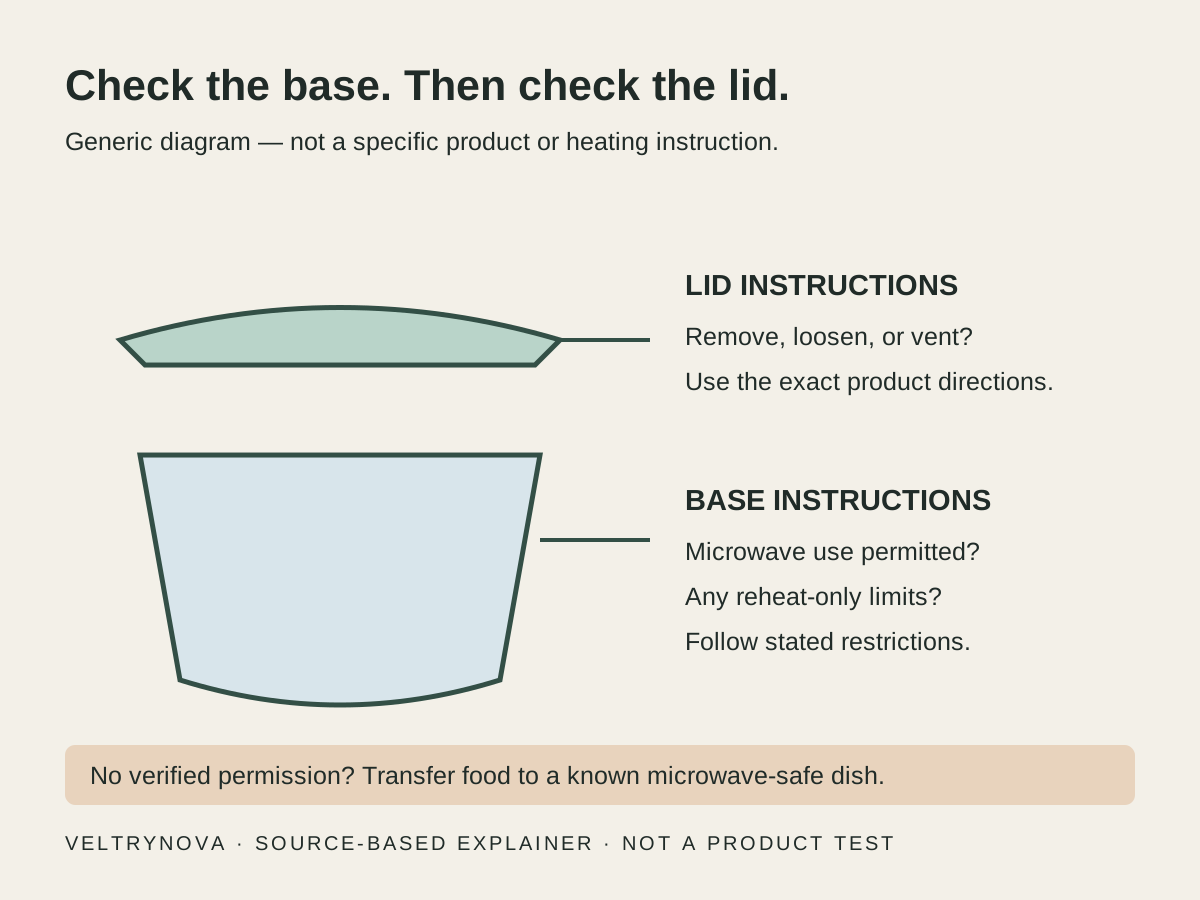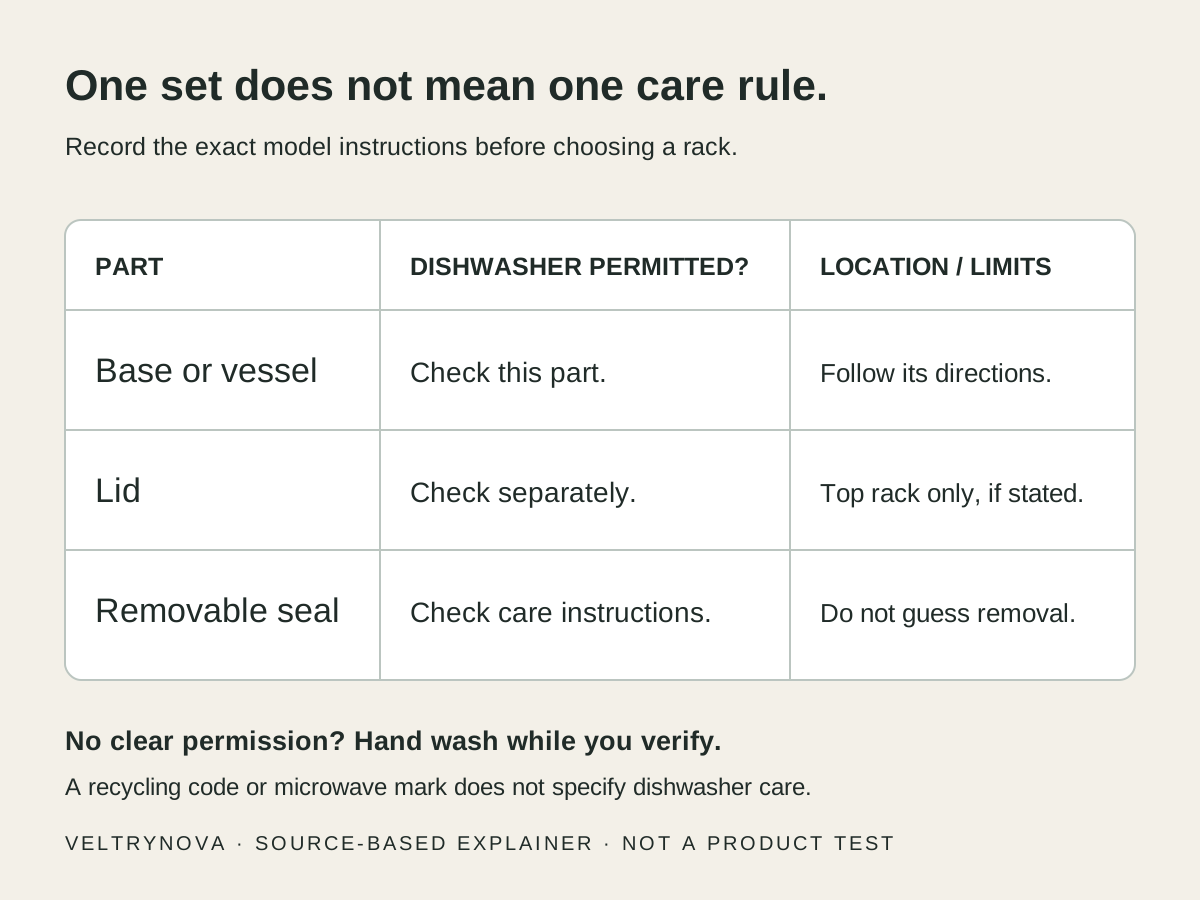
Look for explicit dishwasher-safe wording or the exact product’s care instructions, then check rack and cycle restrictions. If it says top rack only, the bottom rack is not an alternative when the top is full. A microwave mark or recycling number is not a dishwasher instruction, and the lid may have different directions from its container.
Dishwasher symbols are less predictable than many people expect. Finish’s U.S. guide notes that there is no single universally approved dishwasher-safe icon manufacturers must use. A picture of dishes and water can be a useful clue, but you still need to read any accompanying words. Finish’s symbol guide.
Decode the instruction, not just the picture
| Marking or instruction | Your loading decision | Do not assume |
|---|---|---|
| “Dishwasher safe” | Use the permitted rack and cycle stated for that product | That every finish will remain unchanged indefinitely |
| “Top rack only” | Keep that item on the top rack, secured as directed | That a cooler cycle makes bottom-rack use equivalent |
| “Hand wash only” | Leave it out of the dishwasher | That one quick machine cycle is an approved shortcut |
| “Dishwasher safe; hand washing recommended” | Machine washing is permitted, but consider the stated longevity tradeoff | That “recommended” and “required” mean the same thing |
| Only a microwave/freezer mark | Find washing instructions for the exact item | That other appliance permissions apply |
| No identifiable product or care information | Hand-wash using an appropriate method while checking its identity | That material alone supplies the missing permission |
Finish describes common icons as a box containing plates or glasses with water lines or droplets. Instead of relying on the precise droplet pattern, read the rack wording. The guide explains that putting top-rack-only items below can cause warping, discoloration, or other damage. Finish’s top-rack explanation.
Separate the parts before assigning a care method
A glass dish, plastic lid, wooden lid, removable seal, and carrying accessory may look like one set but have separate instructions. Do not give the whole group the base’s permission.
Pyrex’s safety and usage page allows dishwasher cleaning for its listed glassware, calls for the top rack for plastic lids in its plastic-and-wood-lid section, and prohibits dishwasher cleaning for wood lids in that section. It also instructs users to load glassware so it does not bump other items. Follow the section that matches the product you own.
A simple sorting routine is to place parts in three groups before loading: machine permitted, top rack only, and hand wash. Leave an unidentified part out rather than treating an empty space in the rack as evidence it belongs there.
Why the material name is only a starting point
There are useful manufacturer examples, but not a universal “all glass, all plastic, all metal” rule:
- Wood: OXO’s instructions for its wood cutting boards and utensils specify hand washing, no submersion, and no dishwasher. They call for rinsing all sides and drying thoroughly. That is a concrete care plan for those products, not just a warning to “be careful.” OXO wood care.
- Seasoned cast iron: Lodge identifies dishwasher cleaning and prolonged moisture among the situations that can cause seasoned iron to rust. Keep that guidance separate from enameled cookware advice. Lodge’s cast-iron troubleshooting guide.
- Enameled cast iron: Lodge says its enameled pieces are technically dishwasher safe but prefers hand washing to preserve the finish. This is an example of permission and best-maintenance advice differing, rather than contradictory instructions. Lodge enamel care.
- Plastic storage: Rubbermaid lists its Brilliance set, model 2108389, as top-rack dishwasher safe. Apply that statement to the identified set; do not generalize it to a different lunch box with a similar appearance. Rubbermaid product specifications.
These examples are selected to show meaningful differences in instructions. They are not test results, product rankings, or endorsements of those brands over alternatives.
A loading check that takes less effort than replacing a lid
Before closing the door, make four decisions:
- Have I identified every unfamiliar piece? Look at the underside, packaging, or order record for a product-family name or model. Searching the exact identifier is more useful than searching “blue plastic lid.”
- Are the restricted pieces in their permitted location? If the top rack has no space for a top-rack-only lid, leave it for another load or hand-wash it as allowed.
- Have I read all restrictions, not only the permission? Rack limits, disassembly instructions, and washing recommendations need to travel together.
- Does the arrangement follow both sets of instructions? The item maker determines whether the piece tolerates machine washing; the dishwasher manual determines how that machine should be loaded and operated.
This checklist is an editorial workflow. It is meant to turn the product information you already have into a repeatable action, not override your machine’s loading diagram.
If the symbol has rubbed off
Use the brand and model to locate the original instructions; photograph them for the next load. If identification remains uncertain, choose an appropriate hand-washing method rather than running a “test cycle.” Survival of one cycle does not establish that a maker permits repeated machine washing.
When buying replacement kitchenware, compare the whole washing routine: base, lid, seals, and any hand-wash-only components. A set with many pieces may save storage space yet add a separate cleaning task. That practical tradeoff is more useful than treating a dishwasher icon as a complete buying recommendation.
For heating permission, make a separate check with our microwave container guide. Dishwasher compatibility answers how to wash an item, not how to heat food in it.