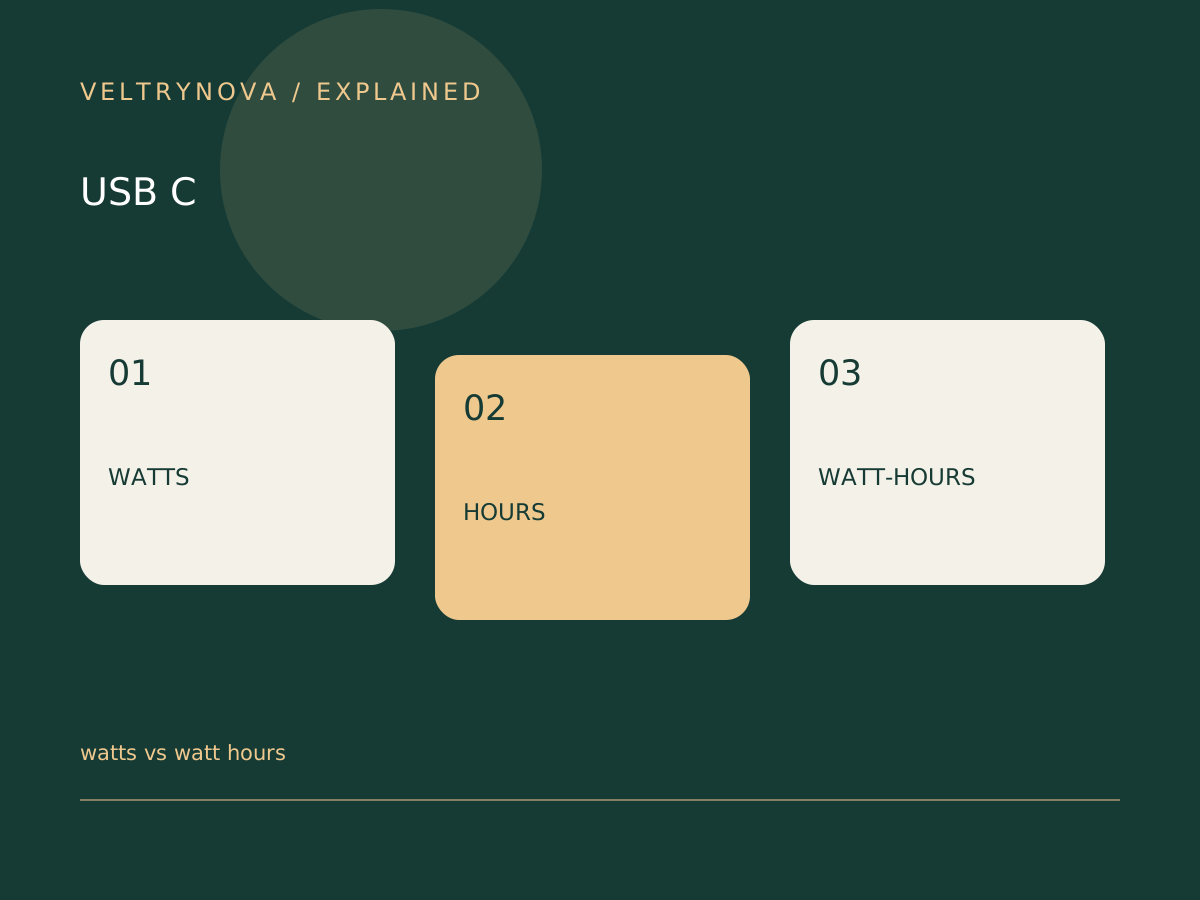
Watts describe power at a moment. Watt-hours describe energy over time. A charger marked in watts and a battery marked in watt-hours are describing related but different quantities.
The arithmetic is straightforward: a constant 10-watt load operating for three hours uses 30 watt-hours. The difficulty is knowing whether the real device actually maintains that load.
Match the unit to the question
For a charger, ask whether its supported output meets the device’s input requirements. For a battery, ask how much usable energy reaches the load. For an electricity bill, ask how long the appliance runs and how its demand changes.
A high-wattage charger is a capacity claim, not a statement that every connected device continuously consumes that amount. Compatible USB Power Delivery equipment negotiates the supported delivery arrangement.
Use estimates with boundaries
Suppose a hypothetical battery provides 60 usable watt-hours to a steady 20-watt load. The idealized estimate is three hours. Conversion losses, reserve capacity, changing workload, temperature, and device shutdown behavior can change actual runtime.
Keep “rated capacity” and “usable delivered energy” separate in any comparison. If a seller lists only milliamp-hours, the associated voltage matters before converting to watt-hours.
Avoid false shopping comparisons
Two power banks with the same headline milliamp-hour figure may not offer identical delivered energy, output capability, or charging speed. Check the stated watt-hours, supported outputs, and the device’s needs.
For travel, consult your airline and the relevant authority’s current battery rules rather than inferring permission from a capacity calculation alone.
See our laptop charger checklist for output matching and dock power budgets when multiple devices share a supply. All numerical examples here are illustrative, not product test results.