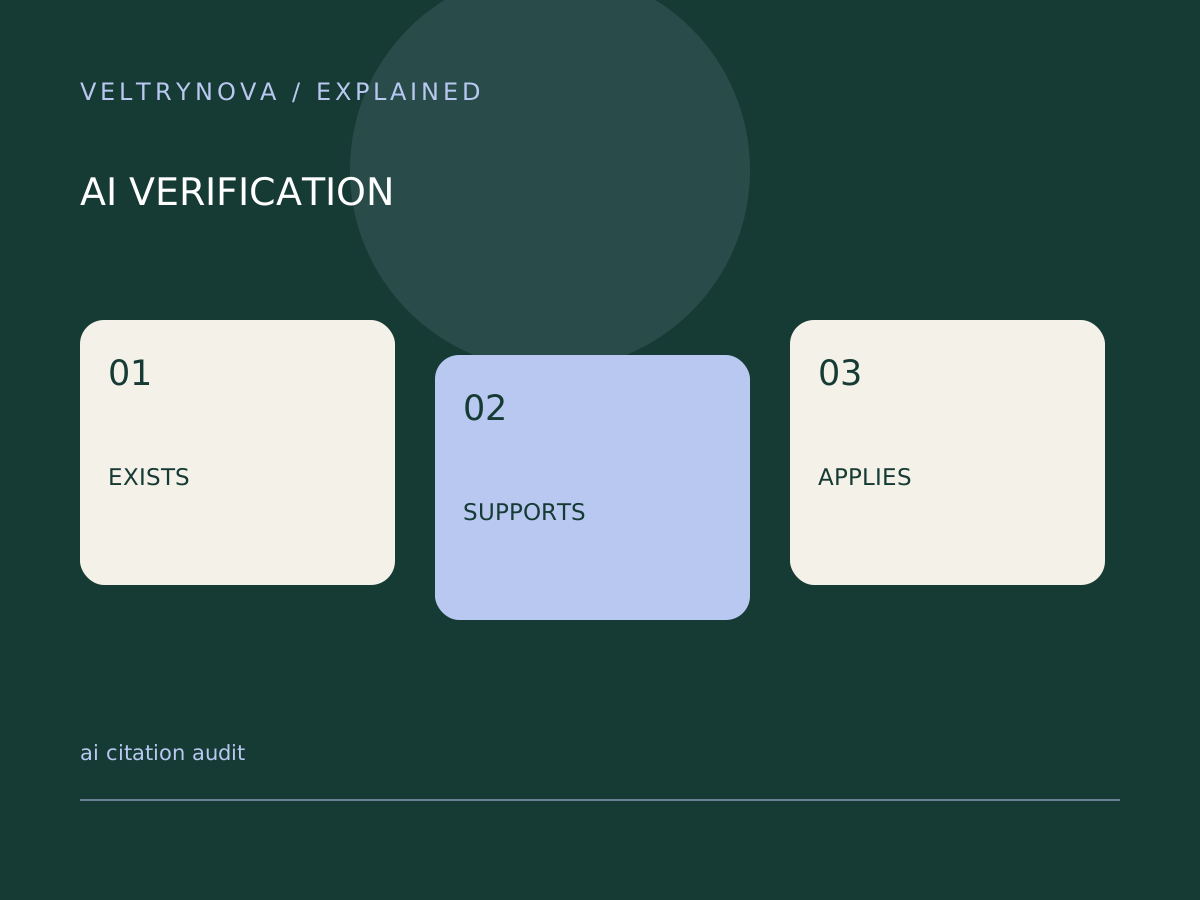
A bibliography can look convincing while providing no reliable support for an answer. Audit citations at the level of the claim you plan to use.
This workflow is an editorial method you can apply to any assistant. It does not depend on a particular product’s browsing feature or a model’s own confidence rating.
Build a claim-to-source table
Choose three statements that would change your decision if wrong. Write each statement in one row, with the proposed source beside it. Separate numerical claims from recommendations and opinions.
Open the source independently. Check the title, author or organization, publication date, and whether the page actually contains the claimed information. A working URL proves only that a page exists.
Read around the supporting passage
Find the relevant paragraph, table, or specification. Check conditions, population, device version, geography, and dates. A source describing a capability does not necessarily establish performance, availability, or suitability.
For a quoted passage, verify the wording. For a number, trace its denominator, time period, and units. If the assistant supplies a summary article, follow its link to the original document where practical.
Resolve uncertainty explicitly
Use labels such as supported, contradicted, incomplete, and not verified. Do not average disagreement away. Ask whether conflicting sources address different circumstances.
If a high-consequence claim remains unresolved, pause the decision and seek the appropriate expertise. NIST’s AI risk work provides broader context for managing model limitations; it does not validate any particular answer.
A useful final note includes the checked claim, source location, access date, and remaining limitation. Save that note with the output so a later reader can reproduce the check.
For a shorter initial screen, use our five-minute AI verification workflow. For buying decisions, apply the same evidence discipline in our holiday comparison worksheet.